
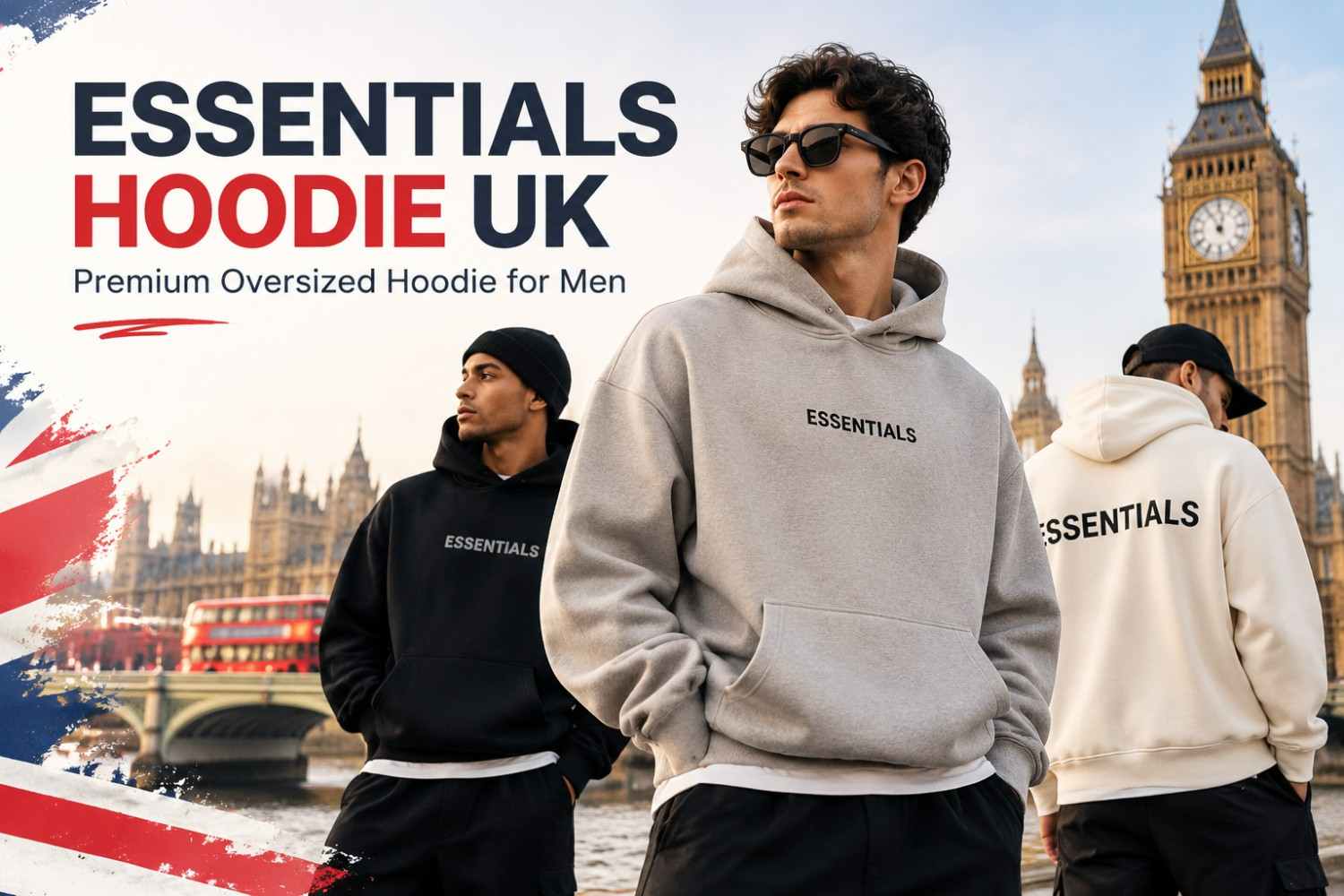
The Essentials Hoodie has become a recognisable staple in contemporary streetwear, known for its relaxed silhouette, understated branding and versatile colour palette. Created under the Fear of God Essentials label, it appeals to shoppers who appreciate minimalist design and comfortable everyday clothing. However, its popularity has also made it a target for counterfeit sellers, leaving buyers wondering how to tell a genuine Essentials Hoodie from a convincing fake.
Whether you are shopping online, browsing resale marketplaces or considering a purchase from an independent streetwear retailer, knowing what to look for can help you make a more informed decision. Small details, including the logo, labels, stitching, fabric and overall construction, can provide useful clues about authenticity.
Price matters too, but a low price alone does not prove that a hoodie is fake, just as a high price does not guarantee that it is genuine.
This guide explains how to identify an authentic Essentials Hoodie, what to check before paying, and how to avoid common purchasing mistakes when shopping in the UK.
What Is an Essentials Hoodie?
An Essentials Hoodie is part of the Fear of God Essentials collection, a more accessible line associated with designer Jerry Lorenzo’s Fear of God brand. The collection focuses on everyday wardrobe staples, combining relaxed fits with relatively understated branding.
Unlike heavily branded streetwear, Essentials typically uses simple designs, muted colours and subtle logo placement. Depending on the release, a hoodie may feature the ESSENTIALS wordmark across the chest, rubberised lettering, reflective branding or a logo detail on the back.
Common characteristics include:
- Relaxed proportions: Many designs feature a loose body, dropped shoulders and a contemporary streetwear silhouette.
- Minimalist branding: The ESSENTIALS name is a prominent design feature, although its placement and finish vary between releases.
- Neutral colours: Shades such as black, grey, cream, taupe and other earthy tones are common across the collection.
- Comfort-focused construction: Hoodies are designed for everyday wear, with details such as ribbed cuffs, a hem and a substantial hood depending on the model.
These characteristics are useful starting points, but they should not be treated as universal rules. Fear of God Essentials has released different collections, fits and finishes over time, so an authentic hoodie may look different from another genuine version.
The most reliable approach is to compare the item with the correct model and release rather than relying on a single feature.
1. Examine the Essentials Logo Carefully
The logo is one of the first things to inspect when buying an Essentials Hoodie. Counterfeit manufacturers often attempt to reproduce the branding, but differences in lettering, spacing, positioning and finish can reveal inconsistencies.
Check the lettering and spacing
Look closely at the ESSENTIALS wordmark. The letters should appear consistent with the branding used on the specific model you are considering.
Pay attention to:
- The shape and proportions of individual letters.
- Consistent spacing between characters.
- Alignment across the chest or back.
- The size of the logo relative to the garment.
- The finish of printed, rubberised or reflective lettering.
A logo that looks unusually thick, uneven or poorly aligned deserves further investigation. However, differences in appearance do not automatically indicate a counterfeit, because branding can vary between releases.
Inspect the logo placement
The position of the logo should correspond with reference images of the same hoodie.
Some styles feature a prominent chest logo, while others use branding on the back, sleeve or another part of the garment. Comparing a listing with official product images can help you establish whether the placement is consistent.
Be cautious if the seller uses photographs of one design but describes or supplies a different model.
Understand the rubberised and reflective finishes
Certain Essentials Hoodie feature raised, rubberised or reflective branding. These finishes can be difficult to assess through ordinary listing photographs.
Ask the seller for close-up images taken in natural light. If the finish looks significantly different from the corresponding reference images, investigate further.
Do not assume that every authentic hoodie must have raised lettering or reflective details. The correct finish depends on the specific release.
2. Check the Neck Label and Wash Tags
Labels are another important part of an authenticity check. They can provide information about branding, garment care and manufacturing, although counterfeit products may reproduce labels convincingly.
Inspect the main neck label
Examine the branding on the inside of the neckline. Look for clear printing, consistent lettering and a finish that appears appropriate for the garment.
Depending on the model, the label design and construction may differ. Therefore, compare it with reliable photographs of the same version rather than using one label design as a universal authenticity test.
Warning signs include visibly misspelt branding, poor-quality printing, inconsistent typography and labels that appear carelessly attached.
Read the care label
The care label may contain useful details about fibre composition, washing instructions and manufacturing information.
Check whether the information is legible and internally consistent. For example, if the seller’s description identifies a particular fabric composition but the garment label states something different, ask for clarification.
A genuine product can be manufactured in different countries across different production runs, so the country of manufacture alone is not a reliable way to determine authenticity.
Likewise, a label that looks professional is not conclusive proof that the garment is genuine.
Look for inconsistencies across the labels
Compare the branding, product description and available product details with the version being sold.
If the seller cannot explain why the garment differs from the reference images, or if several label details appear inconsistent, consider walking away.
3. Assess the Fabric and Overall Quality
Fabric quality can help you identify possible problems, especially when combined with other checks. However, it is important not to rely solely on how thick or heavy a hoodie feels.
Feel the material
Essentials Hoodies are associated with a substantial, comfortable feel, but the exact fabric composition and weight can vary by design.
If you are inspecting a hoodie in person, pay attention to:
- The density and feel of the main fabric.
- The softness and structure of the interior.
- Whether the material feels consistent across the garment.
- The quality of the ribbed cuffs and hem.
- Any obvious fabric defects, loose threads or uneven seams.
An unusually flimsy feel may justify further investigation, particularly if the specific model is known to have a heavier construction. Nevertheless, fabric thickness alone cannot establish whether an item is authentic.
Examine the stitching
Turn the hoodie inside out where possible and inspect the seams.
Look for reasonably even stitching, secure seam joins and clean finishing around the pocket, cuffs and hood. Loose threads, skipped stitches or visibly uneven construction may indicate poor manufacturing quality.
These issues are warning signs rather than definitive proof of counterfeiting. Genuine clothing can have occasional manufacturing imperfections, while counterfeit products can be made with surprisingly neat stitching.
The important question is whether the garment’s overall construction matches the expected quality and design of the specific model.
Check the hood, cuffs and pocket
The hood, ribbed cuffs and front kangaroo pocket contribute to the garment’s shape.
Inspect whether the hood sits evenly, the pocket is attached neatly and the cuffs retain a consistent appearance. Compare these details with photographs of the exact version.
If the garment has an unusual shape, poorly finished edges or noticeably different proportions, ask the seller for more information before buying.
4. Compare the Hoodie with Official Product Images
One of the most practical ways to check an Essentials Hoodie is to find reliable reference images of the exact model.
Rather than searching for a generic image of an Essentials sweatshirt, identify the colourway, branding style and approximate release.
Official Fear of God or authorised retailer product pages are useful starting points. Established retailers may also provide additional photographs showing the front, back, labels and garment details.
What should you compare?
Use the following checklist when comparing the listing with reference images.
| Feature | What to examine |
| Logo | Lettering, spacing, finish and placement |
| Silhouette | Body width, shoulder shape and overall proportions |
| Hood | Shape, volume and construction |
| Position, dimensions and stitching | |
| Cuffs and hem | Ribbing, proportions and finishing |
| Colour | Shade and finish under comparable lighting |
| Labels | Branding and details appropriate to the release |
Remember that photographs can be misleading. Lighting, camera settings and screen displays may affect the apparent colour of a garment.
Also, different production runs or collection releases may introduce legitimate variations. A mismatch should prompt further checks, not an immediate conclusion that the hoodie is fake.
5. Be Careful with Prices That Look Too Good to Be True
Price is an important consideration when shopping for an authentic Essentials Hoodie, particularly if you are buying from a reseller.
However, there is no single price that proves whether a hoodie is genuine. Retail prices can vary by model, release, size and retailer, while resale prices may fluctuate according to demand and condition.
Compare like-for-like products
Before judging a listing, compare the asking price with the same model and colourway from reputable sellers.
Make sure you are comparing equivalent items. A new hoodie from a current collection should not automatically be judged against a worn garment from an older release.
Consider the following factors:
- Whether the hoodie is new, pre-owned or described as unworn.
- Whether the original packaging or purchase documentation is available.
- Whether the seller has a credible sales history.
- Whether the listing price is consistent with comparable items.
- Whether delivery charges or import costs affect the total.
A substantial discount is not proof of a fake, but an unusually low price combined with vague product details and poor photographs should make you cautious.
Watch out for misleading discounts
Some sellers use inflated reference prices to make an offer appear more attractive. Others advertise limited availability or urgent deals to encourage buyers to pay quickly.
Take your time. A legitimate seller should generally be willing to answer reasonable questions about the garment and provide additional photographs.
If the seller pressures you to complete the purchase immediately, avoids basic questions or insists on an irreversible payment method, consider looking elsewhere.
6. Buy from Reputable Retailers and Check the Seller
Where you buy an Essentials Hoodie can make a significant difference to your purchasing risk.
An authorised retailer or an established seller with a clear returns policy generally provides a better starting point than an unknown account offering branded clothing at an unusually low price.
Check the retailer’s reputation
Before ordering, look into the seller’s background.
Check whether the business has verifiable contact information, clear terms and conditions, an understandable returns policy and a consistent record of selling genuine branded clothing.
Independent customer reviews can be useful, but do not rely on star ratings alone. Look for detailed feedback about product accuracy, delivery, returns and customer service.
A polished website does not necessarily mean that the seller is trustworthy. Counterfeit sellers can create convincing online shops, too.
Ask for proof of purchase
If you are buying a pre-owned Essentials Hoodie, ask whether the seller has an original receipt, order confirmation or other evidence of where it was purchased.
Documentation can support a seller’s account of the garment’s origin, but it is not foolproof. Receipts and screenshots can be copied, altered or associated with a different item.
Check that any documentation makes sense alongside the garment itself.
Be cautious on resale marketplaces
Resale platforms can offer access to sold-out colourways, older releases and pre-owned clothing. However, the level of authentication and buyer protection differs between platforms.
Before purchasing, check whether the marketplace offers an authentication service for the item in question, how disputes are handled and whether counterfeit claims are covered by its policies.
Keep communication and payment within the platform where possible. Avoid moving to private messages or off-platform payments simply because a seller offers a discount.
7. Understand Essentials Hoodie Sizing and Fit
Fit is an important part of choosing the right hoodie, especially because the Essentials aesthetic often favours relaxed proportions.
A genuine hoodie may still disappoint if you buy the wrong size, so check the measurements before placing an order.
Expect a relaxed silhouette
Many Essentials Hoodies feature dropped shoulders, a roomy body and sleeves designed to create an oversized appearance.
This does not mean every model fits identically. Some releases may have different proportions, and sizing can vary between styles.
Do not automatically size up because you want an oversized look. Depending on the model, your usual size may already provide the intended silhouette.
Check the size chart
When shopping online in the UK, review the seller’s size chart and compare it with a hoodie you already own.
Useful measurements include:
- Chest width.
- Body length.
- Sleeve length.
- Shoulder width, where available.
For the most useful comparison, lay your existing hoodie flat and measure it in the same way as the seller’s garment.
Pay particular attention to body length and sleeve proportions. A roomy chest with shorter sleeves may fit very differently from a hoodie with a longer, more traditional cut.
Consider how you plan to wear it
If you intend to layer the hoodie over a T-shirt during autumn or winter, a relaxed fit may be practical.
For a cleaner silhouette under a jacket, you may prefer a size that avoids excessive fabric around the body and sleeves.
Remember that an oversized appearance is a styling choice, not a reliable indicator of authenticity.
8. Check the Colourway and Collection Details
Essentials releases include a range of neutral and seasonal colours, with branding and construction details that can change between collections.
Popular-looking shades may be available in several variations, so do not assume that two similarly named colours are identical.
Match the exact colour
Compare the garment with images of the relevant release. Check the shade in different photographs, particularly if the seller’s images make the hoodie look much warmer, cooler or darker than the reference.
A cream hoodie, for example, may appear almost white in bright lighting but look more yellow under indoor lights.
Colour differences alone do not establish that a garment is counterfeit.
Check the release and design
Look at the logo treatment, label design, fit and any distinctive details associated with the particular collection.
If a listing combines features from different versions, ask the seller to clarify the model. A mismatch could reflect inaccurate product information, misleading photographs or a counterfeit item.
Do not rely on claims such as “rare colourway” or “exclusive release” without checking whether the description can be supported.
9. Can You Tell If an Essentials Hoodie Is Fake from Photos?
Sometimes photographs reveal obvious problems, but identifying a counterfeit from images alone is difficult.
A seller may use stock photographs, poorly lit images or pictures that conceal important details. Meanwhile, sophisticated counterfeits can look convincing in online listings.
If you are considering a purchase, request clear, recent photographs of the actual hoodie.
Ask for images showing:
- The front and back of the garment.
- A close-up of the chest or back logo.
- The inside neck label.
- The care label.
- The hood, cuffs and hem.
- Any visible defects or signs of wear.
For a pre-owned hoodie, photographs of the actual item are particularly important. Stock images cannot confirm the condition or authenticity of the garment being sold.
If the seller refuses reasonable requests, provides inconsistent photographs or cannot explain obvious discrepancies, it may be safer to choose another listing.
10. Where to Buy an Authentic Essentials Hoodie in the UK
UK shoppers have several potential purchasing routes, each with different advantages and risks.
Official and authorised retailers
Start by checking Fear of God’s official channels and retailers identified as authorised stockists.
This approach makes it easier to verify the product description, compare the correct release and understand the retailer’s returns policy.
Availability may vary, particularly for older colourways or sold-out sizes.
Established streetwear retailers
Some established fashion retailers stock contemporary streetwear and designer casualwear.
Before buying, verify the retailer’s credentials and check that the item is specifically identified as a Fear of God Essentials product. Do not assume that every shop selling branded streetwear is an authorised seller.
Resale platforms
Resale marketplaces may be useful if you want a discontinued colour, a particular release or a lower-cost pre-owned option.
The trade-off is that you may need to do more of your own checking. Review the seller’s history, available documentation, photographs and buyer protection before committing.
Consider UK delivery and returns
When comparing sellers, look beyond the advertised price.
Check delivery charges, dispatch times, return conditions and whether the business is based in the UK or overseas. For international orders, potential import charges and the handling of returns can affect the overall cost.
If you buy online from a UK business, the Consumer Rights Act 2015 generally requires goods to be as described, of satisfactory quality and fit for their intended purpose. Online purchases from businesses may also carry cancellation rights under the Consumer Contracts Regulations, subject to applicable conditions and exceptions.
If an item is counterfeit or materially different from its description, contact the seller or marketplace promptly and retain the listing, photographs and payment records.
11. How to Style an Authentic Essentials Hoodie
Once you have found a suitable hoodie, its understated design makes it relatively easy to incorporate into an everyday wardrobe.
Casual everyday outfit
Pair a neutral Essentials Hoodie with straight-leg jeans and clean trainers. This combination works well for everyday errands, casual meet-ups and relaxed weekends.
Choose complementary colours rather than trying to match every item exactly.
Minimalist streetwear
For a coordinated streetwear look, combine an oversized hoodie with relaxed-fit trousers and understated trainers.
A black, grey or taupe colour palette keeps the outfit cohesive without relying on bold graphics.
Pay attention to proportions. If the hoodie is particularly roomy, a straight or slightly tapered trouser can create balance.
Layering for British weather
During autumn and winter, wear your hoodie beneath a lightweight jacket, overshirt or suitable coat.
For changeable weather, layering allows you to adjust your outfit throughout the day. Make sure your outer layer has enough room to accommodate the hoodie without restricting movement.
A coordinated Essentials outfit
If you prefer matching pieces, consider pairing the hoodie with complementary items from the wider Essentials Clothing range or exploring an Essentials Tracksuit.
Before buying matching garments, compare their colours, fit and release details. Similar shades may not match perfectly across different collections.
12. Common Mistakes to Avoid When Buying an Essentials Hoodie
Even experienced streetwear shoppers can overlook important details when a listing appears convincing.
Avoid these common mistakes:
- Judging authenticity by the logo alone: Counterfeit products can reproduce branding, so examine several features.
- Assuming a high price means genuine: Sellers can charge premium prices for counterfeit items.
- Using one online guide as a definitive reference: Authentic designs can vary across collections.
- Ignoring the seller’s history: Product photographs matter, but so do the seller’s reputation and policies.
- Buying without checking measurements: A genuine hoodie can still be the wrong fit.
- Relying entirely on packaging: Packaging and tags can be copied, and their absence does not automatically prove a garment is fake.
- Paying outside a marketplace: Doing so may reduce your access to the platform’s buyer protection.
- Ignoring inconsistencies between the listing and garment: Differences in labels, colour, branding or construction deserve clarification.
The strongest approach is to assess the hoodie as a whole. No single detail is sufficient to establish authenticity in every case.
Frequently Asked Questions
How can I tell if an Essentials Hoodie is authentic?
Start by checking the logo, neck label, care label, fabric, stitching and overall construction. Compare these details with reliable images of the exact model or collection. Also investigate the seller’s reputation, purchase documentation and returns policy. No single visual feature can conclusively authenticate every hoodie.
Are fake Essentials Hoodies easy to spot?
Not always. Some counterfeits have obvious problems with lettering, labels or construction, while others can look convincing in photographs. Examining several details together and buying through a reputable seller reduces the risk of making a poor purchase.
Does an Essentials Hoodie need to have a receipt to be genuine?
No. A receipt can help support a seller’s account of where the hoodie came from, but its absence does not automatically mean the garment is fake. Equally, a receipt alone does not prove authenticity. Consider the garment, seller and available evidence together.
Are Essentials Hoodies supposed to be oversized?
Many designs have a relaxed, oversized silhouette with dropped shoulders and a roomy body. However, the fit varies by model and collection. Check the specific size chart and garment measurements rather than assuming every Essentials Hoodie fits the same way.
Can an authentic Essentials Hoodie have imperfect stitching?
Minor manufacturing imperfections are possible in genuine clothing. However, extensive loose threads, uneven seams or poor finishing may warrant closer inspection, especially if other details also appear inconsistent. Stitching should be considered alongside branding, labels and seller information.
Is it safe to buy an Essentials Hoodie from a resale marketplace?
It can be, provided you take sensible precautions. Review the seller’s history, request photographs of the actual garment, check available purchase documentation and understand the marketplace’s authentication and dispute policies. Keep payment and communication on the platform where possible.
Why do Essentials Hoodies have different logos and labels?
The design can vary between collections, releases and garment styles. Branding placement, finishes and label details may differ, so comparisons should be made against the specific version being sold rather than a generic photograph of another Essentials Hoodie.
What should I do if I think my Essentials Hoodie is fake?
Keep the order confirmation, listing screenshots, payment records and photographs of the garment. Contact the seller or marketplace through the appropriate dispute process and explain the inconsistencies. If you paid by card or another protected payment method, check whether additional dispute options are available.
Is a cheap Essentials Hoodie always fake?
No. A lower price could reflect a sale, pre-owned condition or a seller clearing stock. However, a price that seems unusually low compared with similar items should encourage you to investigate the seller, product details and available evidence before buying.
Final Thoughts
Buying an authentic Essentials Hoodie involves more than checking whether the logo looks right. The garment’s labels, construction, fabric, fit and release-specific details all contribute to a more informed assessment.
For UK shoppers, the safest starting point is to compare the exact model with reliable product references and prioritise sellers with clear policies, credible histories and reasonable buyer protection. If you are buying second-hand, request photographs of the actual item and treat receipts or packaging as supporting evidence rather than definitive proof.
Most importantly, avoid rushing into a purchase because of a discount or claims of limited availability. Taking a few extra minutes to check the details can help you choose a hoodie that suits your style, fits as expected and offers greater confidence in what you are buying.
Leave a Reply